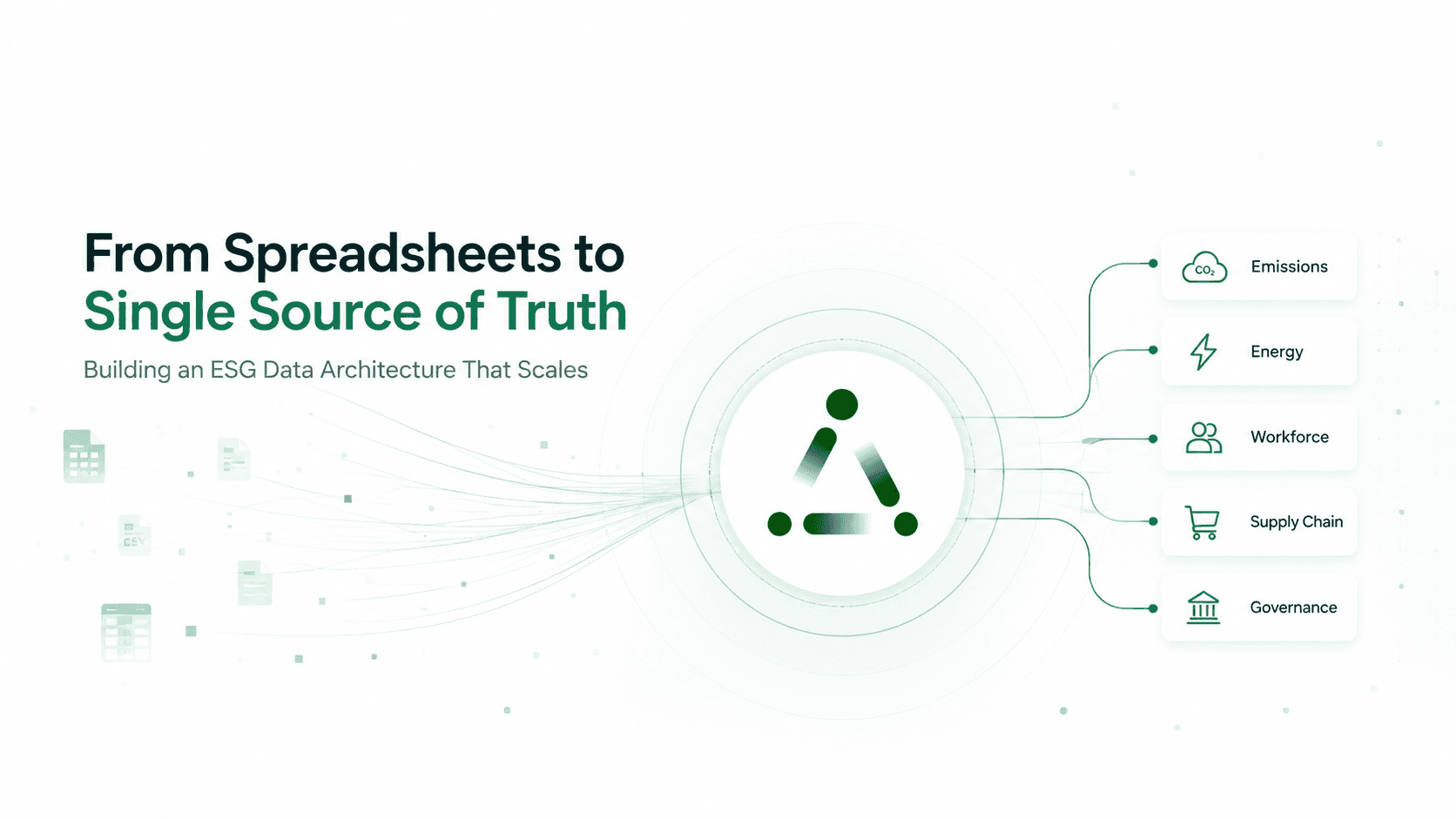
From Spreadsheets to Single Source of Truth: Building an ESG Data Architecture That Scales
Last updated on June 1, 2026 | 5 min read
It usually starts the same way. Someone in finance gets an email asking for last year's energy consumption. They forward it to facilities, who dig up an old workbook and copy a few numbers into a new tab. Procurement adds supplier data from a different file. HR contributes headcounts from theirs. A week later, a sustainability lead is stitching it all together at 9pm, trying to remember whether the electricity figure was in kilowatt-hours or megawatt-hours, and which version of the supplier list was final.
If any part of that feels familiar, you're far from alone. Most sustainability programs don't stall because the strategy is wrong. They stall because the data underneath them can't be trusted. And this isn't a fringe problem: in PwC's 2025 global sustainability reporting survey, 87% of companies said spreadsheets were still their most common reporting technology, while fewer than 30% feel confident in the accuracy of the ESG numbers they produce. A function now subject to audit-grade scrutiny is, for most organisations, still being run on a tool designed for ad-hoc calculation.
Why Spreadsheets Quietly Become a Liability
Let's be fair to the humble spreadsheet first. Almost every ESG program starts in one, and there's nothing wrong with that. They're flexible, familiar, and free. The problem was never the tool. It's what happens when the stakes rise around it, and the spreadsheet stays exactly the same.
Here's where the cracks appear:
Data quality erodes invisibly. A misplaced unit conversion or a hardcoded figure typed over a formula doesn't throw a warning. The file looks fine; it just feeds a wrong number into your disclosure. Little wonder 76% of executives cite data quality as a top ESG reporting challenge.
Data lives in silos. Energy sits with facilities, spend with finance, people metrics with HR. Around 60% of finance leaders struggle with ESG data fragmented across systems, turning every reporting cycle into a manual scavenger hunt.
There's no single version of the truth. When five people email five copies of the same workbook, "report_final_v3_FINAL.xlsx" stops being a joke and becomes a governance failure. You can't assure a number you can't trace.
It doesn't scale. A spreadsheet that works for one site in one year buckles under fifteen sites, three frameworks, and a five-year trend.
The real cost isn't just wasted hours, it's risk. As assurance tightens, and with fewer than 30% of companies ready for mandatory ESG assurance, "trust me, it's in the file somewhere" stops being an acceptable answer to an auditor.
What a Real ESG Data Architecture Looks Like
Moving beyond spreadsheets doesn't mean buying software and crossing your fingers. It means deciding, deliberately, how ESG data is collected, stored, governed, and reported, and treating that as a system. Four principles separate an architecture that scales from one that collapses under its own weight.
1. One source of truth, not many copies. Every data point, a fuel invoice, a payroll figure, a supplier's emissions factor, lives in one governed place. Entered once, referenced everywhere. When your CSRD report, your investor questionnaire, and your internal dashboard all pull from the same record, they physically cannot contradict each other.
2. Connected sources, not endless re-entry. Most of the data you need already exists in your ERP, utility accounts, and HR platform. A scalable architecture connects to those sources and pulls data in automatically rather than asking a human to export and paste it each quarter. This is where the savings live: companies using dedicated ESG software report up to 50% less administrative time and produce reports two to nearly three times faster than those working by hand.
3. Framework-agnostic data, framework-specific outputs. CSRD, VSME, ISSB, SB-253, GRI, most organizations now answer to more than one. The mistake is structuring everything around a single framework, then starting over when the next one lands. Capture the underlying metric once and map it to whichever standards require it.
4. Governance built in from day one. Every figure should carry its lineage: where it came from, who entered it, when it changed. With assurance becoming mandatory, the ability to hand an auditor a clean, traceable trail is the difference between a smooth sign-off and an expensive one.
How Triple I's ECOHUB™ Puts This Into Practice
This is exactly the gap ECOHUB™ was built to close. It isn't another spreadsheet or a generic dashboard bolted onto your existing mess. It's a single ESG architecture where your data actually lives, built for sustainability teams rather than IT departments.
ECOHUB™ integrates directly with your existing ESG and ERP systems through API connections, unifying fragmented sources into one governed source of truth, so a number is entered once and trusted everywhere it appears. Its AI handles the work that drains teams today: ingesting and normalizing messy inputs, validating data, flagging gaps and anomalies before they reach a report, and automatically mapping your data to the frameworks you're accountable for, from the GHG Protocol to enterprise CSRD, VSME, and California's SB-253. In practice, that replaces months of spreadsheet consolidation with fast, auditable carbon accounting and audit-ready templates.
It's also built to be trusted with your data, operating within ISO-certified green data centres with strict tenant isolation, regional data residency, multi-factor authentication, role-based access controls, and compliance with GDPR, PDPL, and SOC 2, all behind intuitive workflows and real-time dashboards in multiple languages.
The result is the shift the best sustainability programs are all quietly making: from manual to automated, from siloed to integrated, and from reactive to predictive. Instead of spending the reporting cycle assembling data, your team spends it acting on what the data shows.
Making the Move Without the Disruption
The fear that keeps teams glued to spreadsheets is a painful migration. In practice it's manageable if you sequence it well: map every place your ESG data currently lives (our ESG readiness assessment is built to surface exactly this), prioritise the metrics tied to your binding disclosures, connect your highest-volume source first for the fastest relief, set ownership and definitions as you go, and retire each old workbook once its source is connected and validated. You don't have to do it all at once, and you don't have to do it alone.
The Bottom Line
Spreadsheets got ESG reporting off the ground, but they were never designed to carry the weight that regulation, assurance, and stakeholder scrutiny now place on them. The companies pulling ahead aren't the ones with the boldest targets, they're the ones whose data they can genuinely stand behind, in front of an auditor, an investor, or a regulator. A single source of truth is what makes everything else possible. So, the question was never whether to move. It's how soon you start.
👉 See how ECOHUB™ turns scattered ESG data into a single source of truth. Book a free demo today at https://triplei.io/book-demo